Every Health Plan Brochure Looks the Same. How Do I Actually Compare Them?
Open enrollment, decoded: deductibles, copays, coinsurance and out-of-pocket maximums in plain English, a worked example, and a free comparison spreadsheet.

Every fall, a stack of health plan brochures shows up. Each one has a smiling family on the cover, usually outdoors, usually near a golden retriever. Each one promises "quality care" and "peace of mind." Each one has a table on page 4 full of words like "coinsurance," which nobody has ever said out loud at a party.
They look identical because, at the level of the cover, they are. The differences hide in a handful of numbers. Once you know which ones, comparing plans stops being a vibe and becomes arithmetic. Slightly annoying arithmetic, but the kind you can do at a kitchen table.
Short version: don't pick the plan with the lowest monthly price. Add up what each plan would cost you in a good year and a bad year, and pick the one whose bad year you could survive.
Six brochures. One golden retriever, reused.
First, the calendar
For plans on HealthCare.gov, open enrollment for 2027 coverage runs November 1, 2026, through January 15, 2027. Sign up by December 15 if you want coverage to start January 1. Sign up between December 16 and January 15 and it starts February 1.
Some states run their own marketplaces with different dates. According to CNBC, Idaho's opens October 15 and Connecticut's October 23. HealthCare.gov will point you to yours.
If you get insurance through work, your employer sets its own window. It's usually in the fall and usually lasts about a month, so check your inbox for the email with "benefits" in the subject line that you've been ignoring. Medicare is separate: its open enrollment runs October 15 to December 7, 2026.
One big thing changed this year. The extra-large premium subsidies that started in 2021 expired at the end of 2025, and as of now Congress hasn't brought them back. The regular subsidies still exist, but for many people they're smaller, and the income cap of 400% of the federal poverty level is back.
Premiums are going up, too: insurers have proposed a median increase of about 15% for 2027, per a Peterson-KFF analysis. So if you're on a marketplace plan, don't just let it auto-renew. Look at the new numbers.
The five words that do all the damage
Premium. What you pay every month just to have the plan, whether you see a doctor or not. It's a gym membership: the charge shows up even in months when you only think about going.
Deductible. The amount you pay for covered care before the plan starts paying its share. It works like the deductible on car insurance: the first chunk of any repair is yours. With a $3,000 deductible, the first $3,000 of covered bills is on you. Here's the comforting part: a car deductible hits every claim, but a health deductible resets once a year. Break your arm in March and your ankle in May, and you only pay it once.
Copay. A flat fee for a specific thing, like $30 for an office visit. It's a cover charge. Some plans charge it before you've met the deductible, some only after; the plan's Summary of Benefits and Coverage says which.
Coinsurance. After the deductible, you and the plan split the bill by percentage. With 20% coinsurance, you pay $20 of every $100 and the plan pays $80. It's splitting the check at a restaurant where you ordered the lobster, and your friend agreed to cover 80% of it. Generous, but a fifth of a lobster is still a lot of lobster.
 Coinsurance: you're both paying, just not equally.
Out-of-pocket maximum. The most you'll pay for covered, in-network care in a year. Deductible, copays, and coinsurance all count toward it. Once you hit it, the plan pays 100% for the rest of the year. This is the most important number in the brochure, and it's usually in the smallest type.
For 2027 marketplace plans, the out-of-pocket maximum can't be more than $12,000 for one person or $24,000 for a family. (A 2027 rule change lets some individual bronze plans go higher, so read each plan's actual number.) A few things don't count: your premiums, anything the plan doesn't cover, and (usually) out-of-network care.
Marketplace plans also come in four "metal" tiers. On average, a Bronze plan pays about 60% of covered costs and you pay 40%; Silver is 70/30, Gold 80/20, Platinum 90/10. The metal isn't about quality of care. If your income qualifies for cost-sharing reductions (lower deductibles and copays), you get them only on a Silver plan.
Here's how the pieces stack up as the bills grow:
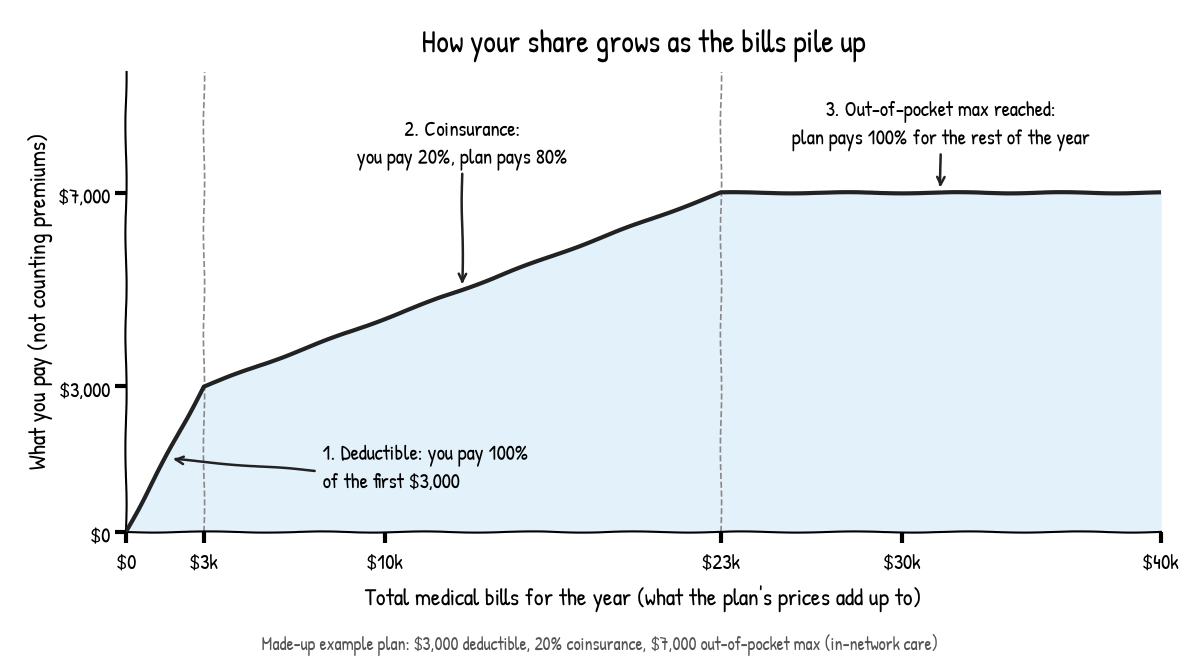 Steep, then gentle, then flat. The flat part is the whole point of having insurance.
A happy side note: most plans have to cover certain preventive services, like many screenings and vaccines, at no cost in network, even before the deductible.
HMO, PPO, and what a "network" is
A plan's network is the doctors, hospitals, and pharmacies that have agreed to the plan's prices. Think of it like your phone carrier's coverage map: inside it, things work and cost what you expect. Outside it, things get expensive or stop working entirely.
An HMO usually covers only in-network care, except in emergencies, and often wants you to get a referral from your primary care doctor before you see a specialist. It's a gated neighborhood with a front desk that wants a permission slip. Premiums tend to be lower.
A PPO lets you go out of network without a referral. You pay more when you do, and the premiums tend to be higher. It's a bigger neighborhood with no gate, but with a toll booth on some streets. The tolls can be steep: out-of-network care may have its own, higher deductible and out-of-pocket max, or no max at all, and the doctor can bill you for the gap between their price and what the plan allows, which is called balance billing.
One real protection: for emergency care, the No Surprises Act shields you from most surprise out-of-network bills.
 Left: smaller, cheaper, there's a front desk. Right: bigger, pricier, there's a toll booth.
The network matters more than the letters. Before you fall in love with a plan, make sure your doctors are in it, and call to check, because online directories go stale.
The worked example: three made-up plans, three made-up years
Let's run the numbers. Every plan and dollar amount below is made up for illustration. Real plans in your area will be different.
| Made-up plan | Premium per month | Deductible | Office visit copay | Coinsurance | Out-of-pocket max |
|---|---|---|---|---|---|
| A: low premium | $320 | $7,500 | $50 | 40% | $9,800 |
| B: middle | $450 | $3,000 | $30 | 20% | $7,000 |
| C: low deductible | $600 | $1,000 | $20 | 10% | $4,000 |
To keep the math simple, office visits cost just the copay, and any bigger bills (a scan, an ER visit, a surgery) go through the deductible and then coinsurance. Everything stops at the out-of-pocket max, and premiums go on top. No employer money or prescriptions yet; those come later.
Now three made-up years:
- Light year: three doctor visits. That's it. You are a person who flosses.
- Medium year: eight visits and $5,000 of other bills. Say, an MRI and a trip to urgent care that turned into a trip to the ER.
- Bad year: 30 visits and a $40,000 surgery. You fell off a ladder while cleaning the gutters, which the brochure did not warn you about.
Here's what each plan costs for the whole year, before any employer money or prescriptions:
| Made-up plan | Light year | Medium year | Bad year |
|---|---|---|---|
| A: low premium | $3,990 | $9,240 | $13,640 |
| B: middle | $5,490 | $9,040 | $12,400 |
| C: low deductible | $7,260 | $8,760 | $11,200 |
Take Plan A's bad year. Premiums are $3,840. Then the bills: 30 copays come to $1,500, the first $7,500 of the surgery is the deductible, and 40% of the remaining $32,500 is $13,000. That's $22,000 on paper, but the out-of-pocket max stops it at $9,800. Total: $13,640.
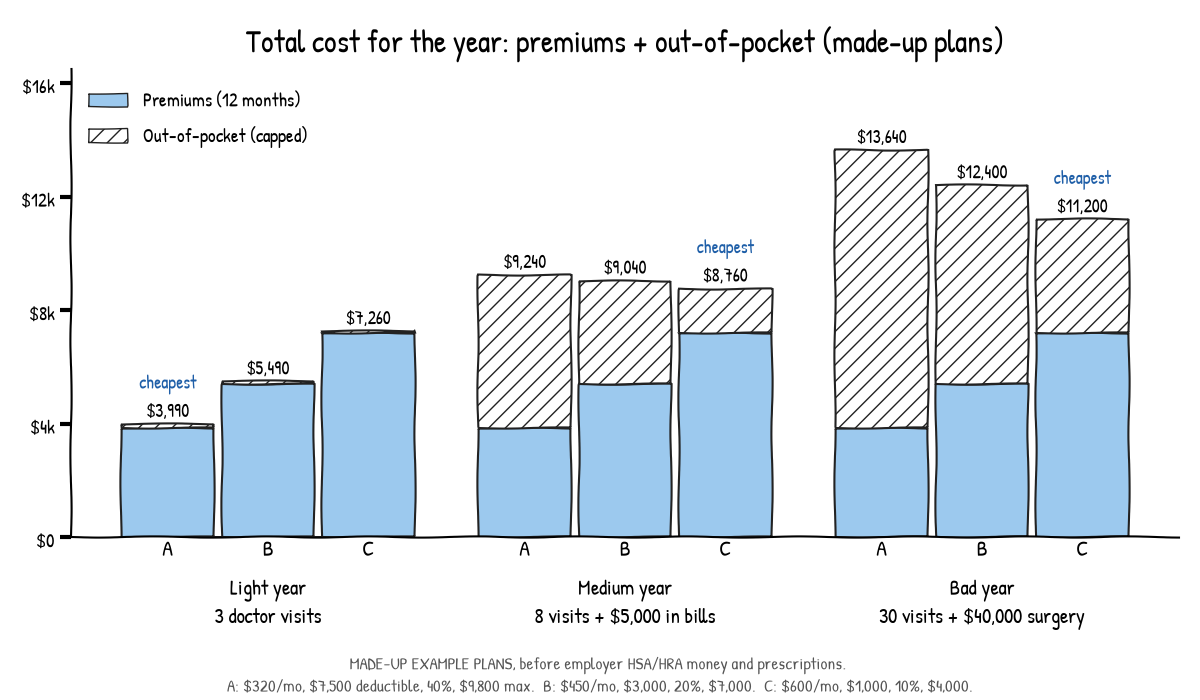 The cheapest plan depends on what kind of year you have. Which, annoyingly, you find out later.
A few things jump out:
- The cheapest premium wins the light year by a lot. Plan A saves $3,270 over Plan C if nothing happens.
- It loses the bad year. Plan A costs $2,440 more than Plan C if something does.
- The medium year is almost a tie. The three plans are within about $500 of each other.
- The bad year has a ceiling. Even Plan A's terrible year stops at $13,640. Without insurance, the same year would run past $40,000. The out-of-pocket max is the reason you're buying this thing.
So the question isn't really "which plan is cheapest?" It's "which bad year can I actually pay for, and how much am I willing to spend every month to make it smaller?" If you'd have trouble covering a $7,500 deductible next March, Plan A is cheap the way skipping the oil change is cheap.
Two things that can flip the answer
Employer money. If a plan is HSA-eligible (usually a high-deductible plan; on the marketplace, every Bronze and Catastrophic plan qualifies), you can put money into a health savings account. The tax break is triple: contributions go in tax-free, they grow tax-free, and withdrawals are tax-free for eligible medical costs. The money stays yours even if you change jobs. For 2027 the limit is $4,500 for self-only coverage or $9,000 for a family, and whatever your employer puts in counts toward it. An HRA is the employer-only cousin: your employer funds it, and you can't add to it. Employer money only comes with job-based plans, but anyone with an HSA-eligible plan, marketplace plans included, can still open an HSA and get the tax break.
Prescriptions. One expensive drug can dominate the math. Look up each of your drugs in every plan's formulary and note its tier; higher tiers cost more.
Here's the same example with two more made-up details: Plan A comes with $1,500 a year of employer HRA money, and you take a daily pill that costs $60 a month on Plan A (pricier tier), $25 on B, and $15 on C.
| Made-up plan | Light year | Medium year | Bad year |
|---|---|---|---|
| A: low premium | $3,840 | $8,460 | $12,140 |
| B: middle | $5,790 | $9,340 | $12,400 |
| C: low deductible | $7,440 | $8,940 | $11,200 |
The medium year flipped from Plan C to Plan A. In the bad year every plan was already at its max, so the pill changes nothing, but the employer money still knocks $1,500 off Plan A. (Employer money only counts up to what you'd actually spend, so in the light year Plan A uses $870 of it.) (That's how an HRA works. With an HSA, unspent money stays yours, so it's worth the full amount, plus the tax break on anything you put in yourself.)
Do it with your own numbers
We made a free spreadsheet that does this math for up to four plans: health-plan-comparison-template.xlsx. It comes filled in with the same made-up example values (in blue), employer money and pill included, so its totals match the second table. Type over them with each plan's real numbers, your employer's HSA/HRA money, and your drug costs, adjust the three years to fit your life, and the totals and a "cheapest in this scenario" column update on their own.
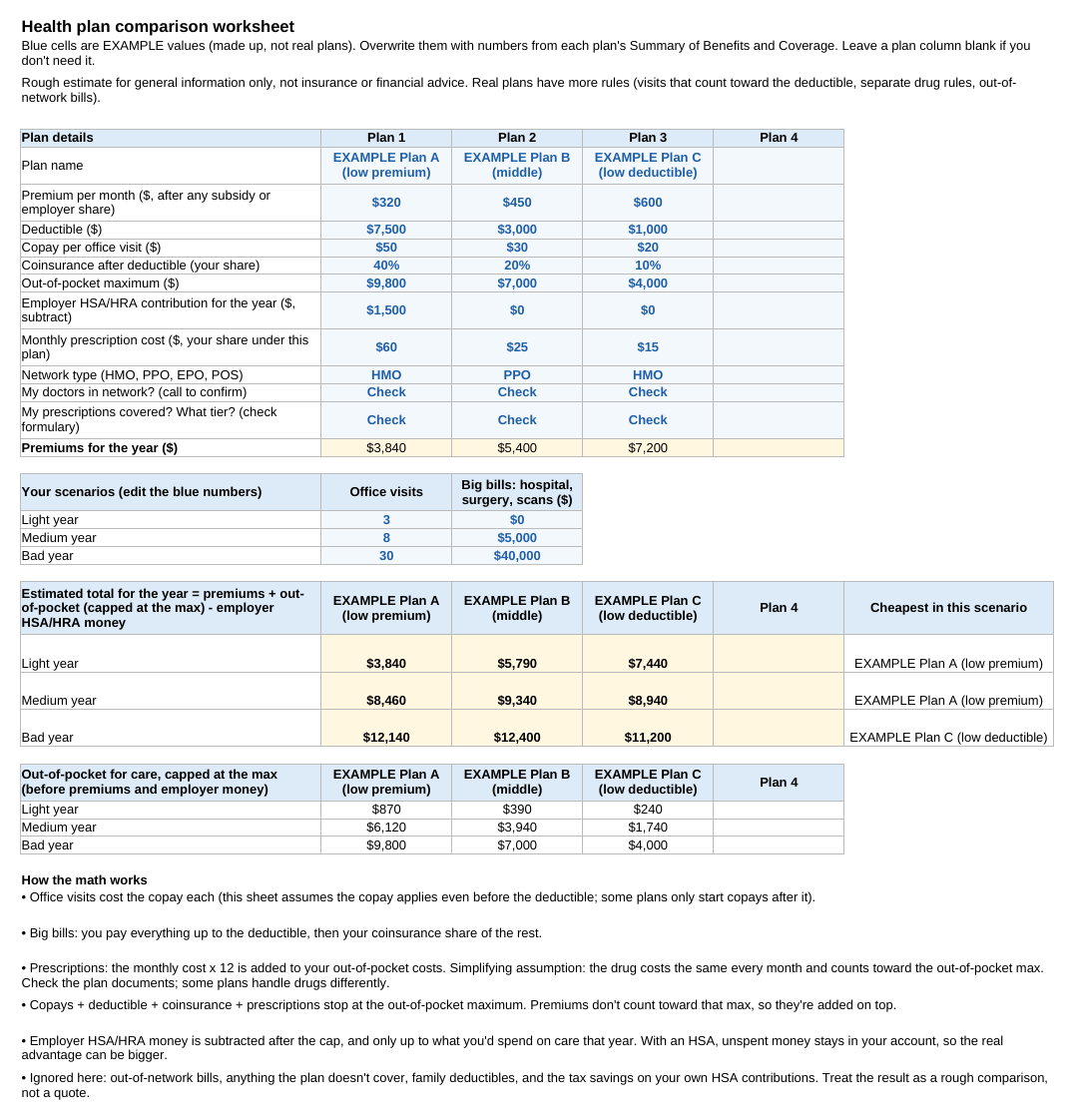 The template, filled with made-up example plans. Overwrite the blue cells.
You don't need Excel. You can open the file in your browser with the EditDocx editor, fill it in, and download it again. There's no signup, and the file stays on your computer instead of being uploaded. (It also works in Excel, Google Sheets, or LibreOffice.) More on how that works in How to Edit XLSX Spreadsheets Online.
The spreadsheet is a rough estimate, not a quote. It ignores out-of-network bills, anything the plan doesn't cover, and family deductibles, and it assumes your drugs cost the same every month. Check the real plan documents before you decide.
What to do this week
 Hold music, the official soundtrack of open enrollment.
- Find your deadline and circle it. December 15 for January 1 coverage on HealthCare.gov. Your employer or state may use a different date.
- Write down what you actually use. Your doctors, your prescriptions, and anything you already know is coming next year.
- Get each plan's Summary of Benefits and Coverage. It's a standard form built for side-by-side comparison.
- Call your doctors' offices. Ask "Are you in network for this specific plan?" Then check each plan's formulary for your drugs.
- Fill in the template for two to four plans. Look hardest at the bad-year row.
- If you're on the marketplace, look before it auto-renews. HealthCare.gov will re-enroll you automatically, but your premium and subsidy may have changed. Type healthcare.gov into the address bar instead of searching. In an August Georgetown study, every top Google result for searches like "Obamacare plans" was a site that sells your contact info to insurance agents, often with an official-sounding name. The agents who called back often pushed short-term and other bare-bones plans that don't have to follow the ACA's rules.
FAQ
Does the out-of-pocket maximum include my premiums?
No. Premiums are separate and keep coming every month. The out-of-pocket maximum caps your deductible, copays, and coinsurance for covered, in-network care. That's why the template adds 12 months of premiums on top.
Is the plan with the lowest premium a bad idea?
Not necessarily. In the first made-up example, the low-premium plan is the cheapest in a light year by more than $3,000 but costs the most in a bad year. Add employer money, though, and it can come out ahead: in the second table it wins the medium year too. It makes the most sense if you rarely need care and could cover the high deductible if something happened.
What's the deadline for 2027 coverage?
On HealthCare.gov, enroll by December 15, 2026, for coverage starting January 1, 2027. Open enrollment ends January 15, 2027, and those later sign-ups start February 1. State marketplaces and employer plans can have different dates.
General information, not insurance or financial advice.
Sources
- HealthCare.gov: Dates and deadlines, Out-of-pocket maximum/limit, Plan and network types, Preventive care benefits, Automatic re-enrollment, Plan categories (metal levels), Cost-sharing reductions, Health Savings Account, Balance billing, Deductible
- CNBC, Health insurance open enrollment: What to know before buying (October 12, 2026)
- CMS, 2027 premium adjustment percentage and maximum cost-sharing guidance; Federal Register, 2027 Notice of Benefit and Payment Parameters final rule
- KFF, Changes to Marketplace premium tax credits; Congressional Research Service, Enhanced Premium Tax Credit FAQ; Peterson-KFF Health System Tracker, 2027 Marketplace premiums
- Georgetown University Center on Health Insurance Reforms, No Good Options: misleading marketing of limited benefit products (August 13, 2026; full report PDF), as reported by CNBC above
- IRS, Rev. Proc. 2026-24 (2027 HSA limits); Publication 969 (HSAs and HRAs); Notice 2026-05 (Bronze and Catastrophic plans treated as HSA-eligible)
- CMS, Medical bill rights (No Surprises Act); Peterson-KFF Health System Tracker, Out-of-network claims in large employer plans; KFF, Checking a plan's drug coverage
- Medicare.gov, Open Enrollment
Image credits
All illustrations, charts, and the template screenshot in this post are original.